
Do You Need a Permit to Install a Home Elevator in Rhode Island, Massachusetts, or Connecticut?
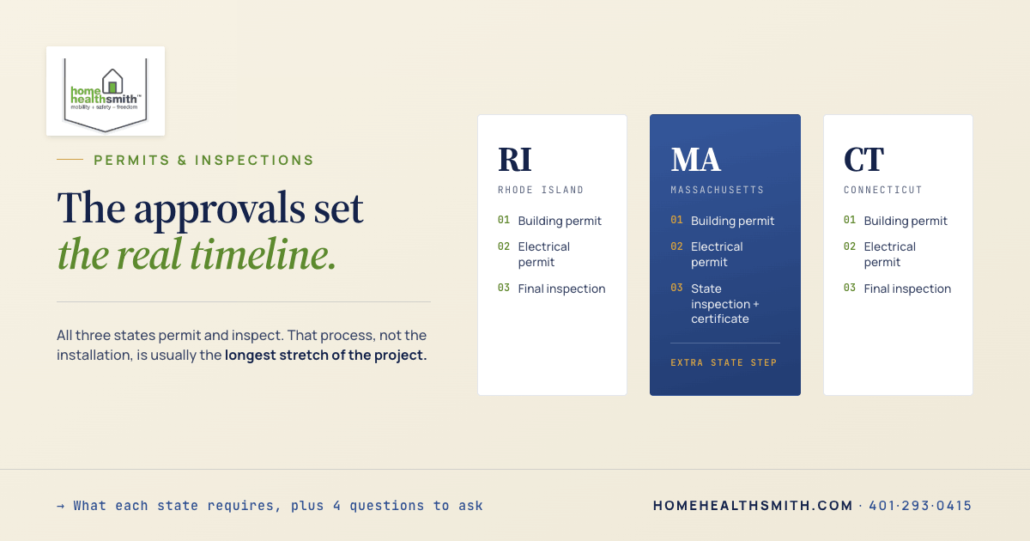
| Yes. A residential elevator is regulated equipment in all three states, and installing one requires permits — typically a building permit and an electrical permit — plus an inspection before the elevator can be put into service. Permitting and inspection are usually the longest part of an elevator project, not the construction itself. At Home Healthsmith, we prepare the permit applications and coordinate inspections as part of every installation, so the paperwork isn’t something you’re left to figure out. |
Why does a home elevator need a permit at all?
An elevator is not a fixture you simply install and switch on. It carries people between floors, it ties into your home’s electrical system, and it usually involves cutting a structural opening in a floor. Each of those things falls under a building code.
Permitting exists so that a licensed official verifies three things: that the structural work is sound, that the electrical supply and disconnect are correct, and that the equipment itself was installed to the manufacturer’s specification and the applicable safety standard. Those checks are what stand between a properly installed elevator and one that fails in five years — or fails while someone is inside it.
Home Healthsmith has been installing and servicing residential elevators across Rhode Island, Massachusetts, and Connecticut for more than 45 years. Permitting is not an obstacle we work around; it is part of how we deliver an installation we’re willing to put our name on.

What permits does a residential elevator installation typically require?
Requirements vary by municipality, but most residential elevator projects in Southern New England involve some combination of the following:
- A building permit, issued by the city or town, covering the structural work — the floor opening, framing, and any hoistway construction.
- An electrical permit, covering the dedicated circuit, disconnect, and any lighting or phone line the equipment requires.
- An elevator permit or registration at the state level, depending on the state and the type of equipment being installed.
- A final inspection and sign-off before the elevator is placed into service.
A project in an older home may also need a plumbing permit if a sump or drain is involved, or additional review if the property sits in a historic district — something that comes up regularly in places like Newport, Providence’s East Side, and much of coastal Massachusetts.
Does Massachusetts require a state elevator inspection?
Yes. Massachusetts regulates elevators at the state level, and a residential elevator generally requires a state inspection and a certificate before it can legally be used. This is in addition to the local building and electrical permits, not a replacement for them.
This surprises a lot of homeowners. They assume that once the town signs off, the job is finished. In Massachusetts, there is a further step — and scheduling that inspection is one of the things that determines when your family can actually start using the elevator.
How do Rhode Island and Connecticut compare?
All three states permit and inspect residential elevator installations, but the mechanics differ — which state agency is involved, whether the equipment is registered, how inspections are scheduled, and how much authority the local building department holds versus the state.
Because those details change from time to time and can vary by municipality, the practical answer is that the requirements for your specific address should be confirmed at the start of the project rather than assumed. That confirmation is part of what we do during the planning stage, before anything is ordered.
“The permit isn’t the hard part. The hard part is a family finding out about it three weeks into the project, when they’ve already made plans around a date. We front-load all of that — we tell you at the assessment what the approvals will involve for your town, so the timeline you’re given is the real one.”
— Bill Bohmbach, CEO, Home Healthsmith. Certified Aging-in-Place Specialist; Executive Certificate for Home Modification.
How much time does permitting add to an elevator project?
More than most families expect, and it’s the main reason the total project timeline is longer than the installation itself. The physical install may be a matter of days for a shaftless model, or a couple of weeks for a traditional elevator with a full hoistway. Permit review, scheduling, and final inspection sit on top of that.
Review times depend on the municipality and its current workload. A small town office and a busy city building department can differ substantially. The useful thing to know is that this portion of the schedule is largely outside any installer’s control — which is exactly why an honest company builds it into the timeline they quote you instead of discovering it later.
For a fuller picture of the whole schedule, see our guide on how long it takes to install a home elevator.
What happens if an elevator is installed without a permit?
Several things, none of them good. Unpermitted work can surface during a home sale and hold up the closing until it’s resolved. Your insurer may take the position that an unpermitted installation isn’t covered if there’s an incident. And the manufacturer’s warranty often depends on the equipment being installed and inspected properly.
There’s also the plain safety question. The inspection is the one independent check that the equipment was installed correctly. Skipping it means nobody outside the installing company ever verified the work.
We occasionally get called to homes where a previous installation was done without permits, sometimes years earlier. Bringing that work into compliance after the fact is almost always more expensive and more disruptive than doing it correctly the first time.
Who is responsible for pulling the permits — you or your installer?
This is the question worth asking before you sign anything, because the answer genuinely varies between companies.
Some installers hand the homeowner a parts list and leave the permitting to them or to a general contractor. Others handle it end to end. The distinction matters most when something needs to be corrected: if you pulled the permit, the correction is your problem to solve and coordinate.
At Home Healthsmith, permit preparation and inspection coordination are part of the installation. Our team works directly with your building department and, where required, the state — and with your contractor or electrician if the project involves one.
What should you ask an elevator company about permitting?
Four questions will tell you most of what you need to know:
- Who prepares and submits the permit applications for this project?
- What approvals does my specific town and state require for this equipment?
- Is the permit and inspection timeline reflected in the schedule you’ve quoted me?
- Who handles it if the inspector requires a correction?
A company that answers those clearly and specifically has done this before in your area. A company that gets vague is telling you something too.
Frequently asked questions
Can I install a home elevator myself to avoid the permit process?
No — and the permit isn’t the reason. Residential elevators are engineered systems with load, clearance, and safety-device requirements that have to be met precisely. Most manufacturers only sell through trained, authorized dealers, and self-installation voids the warranty. The permit requirement applies regardless of who does the work.
Does a shaftless elevator still need a permit?
Yes. A shaftless home elevator involves less construction than a traditional model, but it still requires a floor opening, a dedicated electrical circuit, and inspection before use. Lighter construction does not mean lighter regulation.
Will my homeowners association or condo board need to approve this too?
Very possibly, and it’s a separate process from municipal permitting. Condo associations in particular often have their own review for work affecting the structure or common elements. If you’re in a condo or an HOA, start that conversation early — it can run longer than the town’s review.
Does Home Healthsmith handle permits in all three states?
Yes. We serve Rhode Island, Massachusetts, and Connecticut, and we handle permit preparation and inspection coordination throughout our service area. If your project involves a general contractor or electrician, we coordinate with them as well.
What if my home is in a historic district?
It’s usually still possible, but there may be an additional review, particularly if the work affects the exterior. Interior elevator installations are often less contentious than owners fear. We’ll flag this at the assessment if your property is affected.
The next step
If you’re weighing an elevator for your home or a parent’s home, the most useful thing you can do right now is find out what your specific address actually requires — before you build a timeline around a guess.
| Schedule a free SafeHome Audit
A Home Healthsmith specialist will visit the home, assess the layout and the person’s needs, and give you a clear picture of the equipment, the approvals your town requires, and a realistic schedule — along with a written estimate. There’s no cost and no obligation. Call (401) 293-0415 or request your SafeHome Audit online. Serving Rhode Island, Massachusetts, and Connecticut. Showroom: the Accessibility Living Suite, 207 Highpoint Ave., Ste 2, Portsmouth, RI. |