
What Does It Cost to Maintain a Home Elevator — and Who Services It?
| A residential elevator should be professionally serviced at least once a year. That annual service visit is the main ongoing cost of ownership; beyond it, most owners budget for occasional wear items such as batteries and door components as the equipment ages. The larger question isn’t the dollar figure — it’s whether the company that installed your elevator will still be servicing it in ten years. At Home Healthsmith, ongoing service is built into the SafeHome Advantage program, so maintenance isn’t something you have to remember to arrange. |
Why does a home elevator need regular maintenance?
Because it is a mechanical system that carries people, and because most of what wears out on an elevator is invisible from inside the cab.
A residential elevator has a drive system, guide rails, door interlocks, safety switches, and a battery backup. Every one of those has a service life. When an elevator is maintained on schedule, the things that wear are caught and replaced while they’re still inexpensive. When it isn’t, the first sign of a problem is often the elevator stopping — sometimes with someone in it.
There’s also a warranty dimension. Manufacturers generally require documented annual service to keep coverage intact. Skipping maintenance to save money can quietly cost far more the first time a major component fails outside of warranty.
Home Healthsmith has been installing and servicing residential elevators across Rhode Island, Massachusetts, and Connecticut for over 45 years, for more than 5,000 clients. A meaningful share of our work is servicing equipment — including equipment other companies installed and then stopped supporting.
How often should a residential elevator be serviced?
At minimum, annually. Homes where the elevator is used many times a day, or where it’s a primary means of access rather than a convenience, may benefit from more frequent visits.
Usage is the real variable, not age. An elevator in a home where someone uses a wheelchair and travels between floors a dozen times a day accumulates cycles far faster than one used twice a week. We set the interval based on how the equipment is actually used in your home.

What does a maintenance visit actually include?
A proper service visit is considerably more than a look and a listen. It typically covers:
- Inspection and adjustment of the drive system and guide rails.
- Testing every safety device — door interlocks, limit switches, emergency stop, and the alarm or phone.
- Checking and, where needed, replacing the battery backup so the cab can still reach a floor during a power outage.
- Lubrication and adjustment of moving parts and door operation.
- Verifying the cab levels correctly at each floor — a misaligned stop is a trip hazard at the threshold.
- A written record of what was checked, what was adjusted, and what is beginning to wear.
That last item matters more than it sounds. A maintenance record tells you what’s coming, which means expenses are planned rather than sudden.
What drives the ongoing cost of owning a home elevator?
Four things, roughly in order of impact:
- Service frequency — how often the equipment is visited, which follows from how heavily it’s used.
- Equipment type — different drive systems have different service needs and different wear items.
- Age and condition — a well-maintained fifteen-year-old elevator often costs less to keep running than a neglected eight-year-old one.
- Whether you’re on a service plan or calling for help reactively — planned maintenance is consistently less expensive than emergency repair.
We keep specific pricing to the conversation rather than a blog post, because it depends on your equipment and how you use it. What we can say plainly is that ongoing maintenance is a small fraction of what the elevator itself costs — and dramatically smaller than a major repair caused by skipping it.
“Families think very hard about the purchase and almost not at all about year three. But the reason someone can stay in their home is that the elevator works every single day — not that it worked beautifully the week it went in. When we install something, we’re signing up for the decade after it, and that’s the part people should be asking about.”
— Linda Bohmbach, Home Healthsmith. Certified Dementia Practitioner; Executive Certificate for Home Modification.
What parts tend to wear out on a residential elevator?
The battery backup is the most common replacement item. Batteries have a finite service life, and a dead backup battery means the cab can’t reach a floor if the power drops — a real consideration in New England, where storm outages are routine.
Beyond batteries, the usual wear items are door components and interlocks, which see the most physical use, and control or safety switches. Structural components and the drive system itself are generally long-lived when properly maintained.
Who services your elevator after the installer leaves?
This is the question we’d most want a family to ask, and it’s the one most often skipped.
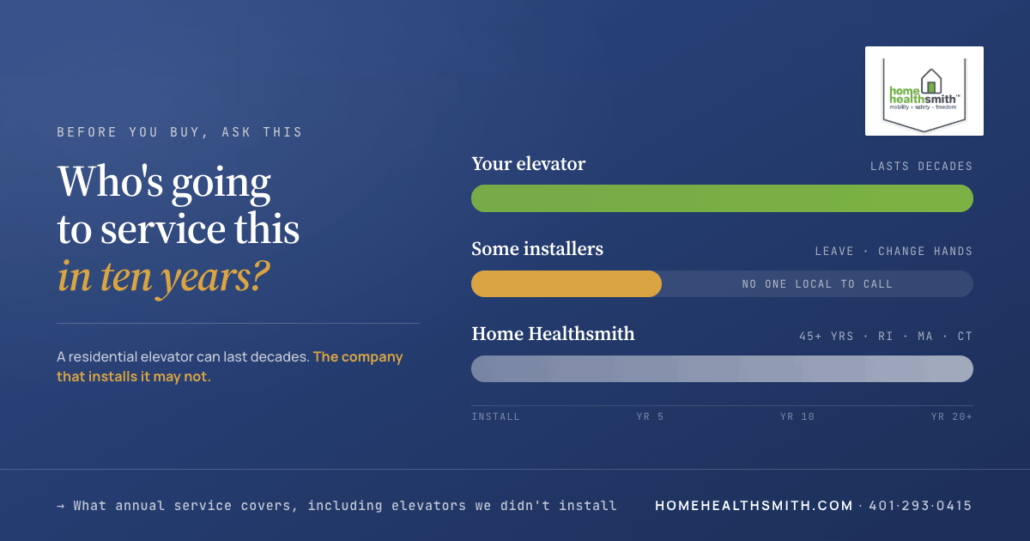
A residential elevator can last decades. The company that installs it may not. When a homeowner buys from an installer who leaves the region, changes ownership, or stops servicing residential equipment, they’re left owning a piece of machinery that nobody local knows how to work on.
It’s a specific and unpleasant situation, and we see it. Homeowners call us with an elevator that stopped working and no one to call — sometimes an orphaned brand, sometimes a company that simply no longer exists.
Before you buy, ask any elevator company three things: how long they’ve been servicing residential equipment in your state, whether they service what they sell, and whether they’ll work on the brand you’re considering ten years from now.
What is the SafeHome Advantage?
The SafeHome Advantage is Home Healthsmith’s ongoing home support program. Rather than leaving maintenance as something you have to remember, it builds a continuing relationship around the equipment and the home.
Members receive regular safety audits, in which our technicians review the equipment and check the wider home — loose handles, poor lighting, developing trip hazards. Membership also includes discounts on community resources and basic home maintenance.
The underlying idea is straightforward: needs change. The home that was right two years ago may not be right now, and someone should be looking.
Frequently asked questions
Can I skip a year of maintenance if the elevator seems fine?
We’d advise against it. Elevators generally run normally right up until they don’t, and the components most likely to fail — safety switches, interlocks, the backup battery — give no warning from inside the cab. Skipping service may also affect your manufacturer’s warranty.
Will you service an elevator your company didn’t install?
In most cases, yes. We service a range of residential elevator brands across Rhode Island, Massachusetts, and Connecticut, including equipment installed by companies no longer operating in the area. Call us with the brand and approximate age and we’ll tell you honestly whether we can help.
What happens if the power goes out while someone is in the elevator?
Residential elevators are designed with this in mind. Battery backup allows the cab to reach a floor and the doors to open during an outage. This only works if the battery is healthy — which is precisely why it’s checked at every service visit.
Does maintenance cost change as the elevator gets older?
Somewhat. Early years are typically routine service. As equipment ages, wear items come due more often. A consistently maintained elevator ages gradually and predictably; a neglected one tends to present several problems at once.
Is maintenance included when I buy an elevator from Home Healthsmith?
Every installation includes our SafeHome Install process, with follow-up at two weeks, six months, and twelve months. Ongoing coverage beyond that is handled through the SafeHome Advantage program. We’ll walk you through exactly what’s included before you commit to anything.
The next step
If you already own a residential elevator and can’t remember its last service, that’s worth resolving — particularly heading into storm season, when a healthy backup battery stops being theoretical. And if you’re still deciding on an elevator, ask about the decade after the install, not just the install.
| Schedule a free SafeHome Audit
A Home Healthsmith specialist will assess the home and the person who lives in it — existing equipment included — and give you a clear picture of what’s needed and what it costs. No cost, no obligation, no pressure. Call (401) 293-0415 or request your SafeHome Audit online. Serving Rhode Island, Massachusetts, and Connecticut. Showroom: the Accessibility Living Suite, 207 Highpoint Ave., Ste 2, Portsmouth, RI. |