
How Long Does It Take to Install a Home Elevator?
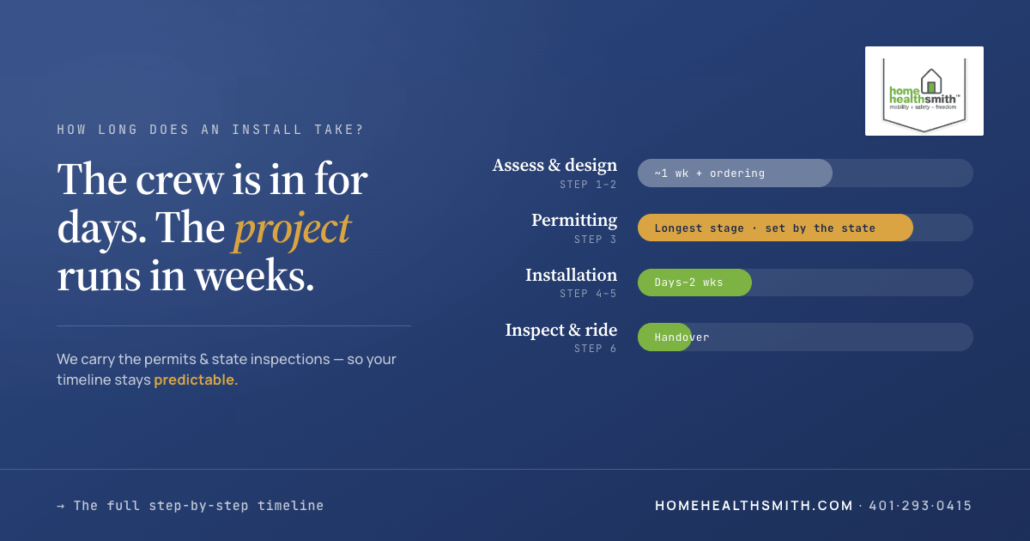
The physical installation is usually quick — often just a few days for a shaftless model, and up to a couple of weeks for a full traditional elevator. The longer part of the timeline is everything around it: the in-home assessment, design, permitting, and any structural prep. For most New England families, planning and approvals take more calendar time than the install itself, which is exactly why it pays to start before you urgently need it.
Home Healthsmith has installed residential elevators across Rhode Island, Massachusetts, and Connecticut for more than 45 years, and today we’re one of the fastest-growing elevator installation teams in New England. Part of what makes a project run on schedule is handling the pieces families dread — permits, state elevator inspections, and coordination with your contractor and electrician — so the timeline stays predictable.
What are the steps in a home elevator installation?
Every project moves through the same basic sequence, whether it’s a shaftless unit or a full traditional elevator:
- In-home assessment (SafeHome Audit): we look at the space, floors served, and the person’s needs.
- Design and product selection: choosing the elevator line, size, and finishes that fit the home.
- Permitting: filing the required paperwork with the local and state authorities.
- Site preparation: any framing, floor opening, or electrical work the model requires.
- Installation: setting the rails and cab and connecting the drive system.
- Inspection and handover: state inspection where required, then a walkthrough of how to use and maintain it.
How long does each stage take?
As a general picture for New England homes — exact timing depends on the model and your home:
- Assessment to proposal: often within a week of your visit.
- Design and ordering equipment: a few weeks, depending on the line and configuration.
- Permitting: variable — this is frequently the longest single stage, driven by local review timelines.
- Installation on site: a few days for a shaftless elevator; up to roughly two weeks for a full traditional installation with more construction.
So while the crew may only be in your home for a matter of days, it’s smart to think of the whole project in weeks from first call to first ride.
“The install is the visible part, but the real timeline lives in the coordination — the permits, the state documentation, keeping the contractor and the family in sync. Our job is to carry that so a family isn’t chasing paperwork. When everyone knows the next step, the whole project moves faster and calmer.”
— Linda Bohmbach, Certified Dementia Practitioner & Integrator, Home Healthsmith
Why does permitting take longer than the install itself?
Residential elevators are regulated equipment. Depending on your city and state, the project needs building permits and — in states like Massachusetts — a state elevator inspection and permit for use before the elevator can be operated. Those review timelines are set by the authorities, not the installer, so they’re the part of the schedule least in anyone’s direct control.
This is where working with an experienced local team matters. We prepare the technical documentation state regulators require and manage the inspection process, which keeps a project from stalling on a technicality.
“The project met all the requirements for elevator inspection with the Massachusetts elevator inspectors office and was given a permit for use by the State. Linda provided all the technical documentation for the State regulations, and her associates kept me and my general contractor well informed every step of the way.”
— Colby R., Mattapoisett, MA (Home Healthsmith client)
What can slow a home elevator project down?
A few common factors:
- Permit review timelines that vary by municipality.
- Structural surprises uncovered once work begins in an older home.
- Custom finishes or sizing that extend equipment lead time.
- Coordinating trades — electrical or general contracting work that has to happen in sequence.
Most of these are manageable when they’re anticipated up front, which is the whole point of a thorough assessment before anything is ordered.
How can I make the process go faster?
Start earlier than feels necessary. The families who have the smoothest experience are the ones who plan before a crisis — they have time to choose the right model, let permitting run its course, and schedule installation for a convenient window. Booking the in-home assessment is the single step that sets everything else in motion.
“I can’t believe how hard they work, and how well they communicate with each other. My contractor commented on the installers’ work ethic. I’m totally impressed with the quality of workers, from the office folks to the installers.”
— Kathy M., Dorchester, MA (Home Healthsmith client)
Frequently Asked Questions
How long does a shaftless home elevator take to install?
The on-site installation for a shaftless model is often just a few days, since there’s no full hoistway or machine room to build. Planning and permitting still happen first, so budget a few weeks overall from first call to first ride.
Do I have to move out during installation?
In most cases, no. The work is contained to the installation area, and while there will be some noise and dust during the active construction days, families typically stay in the home throughout. We’ll tell you exactly what to expect for your project.
How far in advance should I start planning?
Sooner is better. Because permitting timelines are outside anyone’s control and equipment can take weeks to arrive, starting a few months ahead of when you’ll truly need the elevator gives you the calmest path and the most options.
Who handles the permits and inspection?
Home Healthsmith does. We prepare the required documentation, file for permits, and coordinate the state elevator inspection where it applies, so you’re not managing regulatory paperwork on your own.
Can a home elevator be installed in the winter?
Yes. Because the work is interior, elevator installation isn’t limited to warm months. That said, planning during the summer or early fall means your elevator can be ready before winter weather makes stairs riskier.
| Let’s map your timeline.
Every home is different, and the only way to give you a real timeline is to see your space. Book a free SafeHome Audit — call (401) 293-0415 or schedule your visit. Learn more about our Harmar home elevators and how the SafeHome Advantage keeps your elevator running for decades after install. |