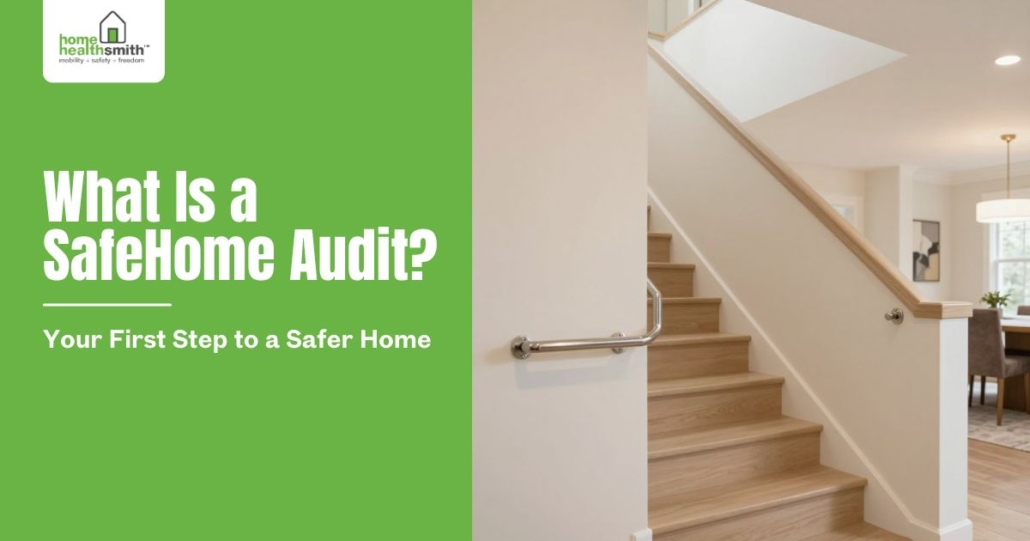
What Is a SafeHome Audit? Your First Step to a Safer Home
You know something needs to change. Maybe a parent took a fall. Maybe you’ve noticed them gripping the wall on the stairs. Maybe nothing has happened yet — but you’re watching, and you’re worried.
The challenge most families face isn’t a lack of willingness to act. It’s not knowing where to start. What needs to change? What can wait? And how do you make sure you’re spending money on the right things — the modifications that will actually make a difference?
That’s exactly what a SafeHome Audit is designed to answer.
What Is a SafeHome Audit?
A SafeHome Audit is Home Healthsmith’s proprietary in-home safety assessment — a comprehensive, expert-led review of your home designed to identify safety risks, mobility challenges, and accessibility gaps before they become emergencies.
It is conducted by a certified specialist — not a salesperson, not a general contractor, but a trained professional whose job is to understand how your home’s design interacts with the specific needs of the person living in it.
The audit covers your entire home, from the driveway to the back bedroom, and results in a written report that tells you exactly what we found and what we recommend — with no obligation to act on any of it.
“We start our safety audit at the driveway and work our way in to determine any potential hazards that may put you at risk.” — Bill Bohmbach, CEO, Certified Aging-in-Place Specialist
What Does the Audit Cover?
A SafeHome Audit is room-by-room and comprehensive. Here is what our specialists examine:
Entry and Exterior
- Driveway and pathway surface condition and lighting
- Front steps: height, width, handrail presence and stability
- Door threshold heights and door handle types (knobs vs. lever)
- Ramp viability for wheelchair or walker access
Stairways
- Staircase width, riser height, and handrail condition on both sides
- Lighting at top, middle, and bottom of staircase
- Stairlift suitability: stair shape (straight vs. curved), wall clearance, electrical access
- Whether a residential elevator or vertical platform lift would better serve multi-floor access needs
Bathroom
- Grab bar presence, placement, and load capacity (are they actually anchored to studs?)
- Tub and shower transfer risk: step-over height, shower entry configuration
- Toilet height and transfer support
- Flooring: slip resistance when wet
- Vanity and medicine cabinet accessibility
Bedroom
- Bed height and transfer support
- Pathway width for walker or wheelchair
- Light switch height and accessibility from bed
- Door width (minimum 32″ for wheelchair clearance)
Kitchen and Living Areas
- Flooring transitions and rug trip hazards
- Counter height and reach accessibility
- Cabinet hardware and appliance controls
- General pathway clearance throughout
At the end of the visit, you receive a written SafeHome Report that documents every finding, prioritizes recommendations from most urgent to future planning, and includes an estimate for any modifications our team can help with.
Who Conducts the Audit?
This is where the SafeHome Audit is meaningfully different from a general contractor’s walkthrough or a home inspection.
Our audit specialists are certified professionals. Bill Bohmbach, HHS’s CEO, is a Certified Aging-in-Place Specialist (CAPS) — a designation from the National Association of Home Builders that requires specific training in the intersection of aging, mobility, and home design. He also holds an Executive Certificate for Home Modification Program.
Linda Bohmbach is a Certified Dementia Practitioner — a credential that matters enormously for families whose loved one has a dementia diagnosis, where safety risks are different and require specialized knowledge to identify and address.
This isn’t a checklist exercise. It’s a professional assessment conducted by people who have spent decades understanding how homes need to evolve for the people who live in them.
How Is This Different From Just Getting a Quote?
It’s a fair question. Many accessibility companies will come to your home and give you a quote for a specific product you’ve already decided you want. That can be useful — but it’s not the same thing.
A SafeHome Audit starts from a different place. Instead of beginning with a product, it begins with a person. We’re asking: What are the actual risks in this home for this individual? What matters most right now? What can wait? And what solutions — whether it’s a $200 grab bar or a $10,000 elevator — will genuinely make the biggest difference?
Families frequently tell us that the audit revealed risks they hadn’t noticed — a bathroom door that couldn’t be opened from the outside in an emergency, a stair riser that was an inch higher than the others, a grab bar installed into drywall with no structural support. These are the things a trained eye catches that a worried family member might not.
“Home Healthsmith’s SafeHome Audit provides exactly the kind of thorough assessment every family needs when considering aging in place. During this visit, our specialists meet with you to discuss your mobility needs, personal goals, and home upgrade project ideas.”
What Happens After the Audit?
The audit produces a written report and an estimate. From there, the path forward is entirely yours.
Some families use the report to prioritize a phased approach — tackling the highest-risk modifications first and planning larger projects over time. Others are ready to move forward immediately. Some share the report with a parent’s primary care physician or occupational therapist. Others use it simply to confirm that the home is already in good shape and that minor adjustments are all that’s needed.
If you do decide to move forward with modifications, the next step is the SafeHome Install™ — our professional installation process — followed by the SafeHome Advantage program for ongoing year-round support.
Is the SafeHome Audit Really Free?
Yes. There is no charge for the initial SafeHome Audit. We’ve structured it this way because we believe the right starting point for every family is an honest, expert assessment — not a sales pitch.
We have been doing this for more than 40 years. We know that the families who begin with a thorough assessment make better decisions, end up with solutions that actually work, and become the clients who call us back when their needs change. The audit is how we earn the right to that long-term relationship.
Who Should Schedule a SafeHome Audit?
A SafeHome Audit is the right first step if:
- A parent or family member has had a fall, a near-miss, or a recent hospitalization
- You’re noticing your loved one avoiding stairs, gripping walls, or avoiding the bathroom
- You’re beginning to plan for aging-in-place and want to understand what your home will need
- You’ve been told a modification is needed but aren’t sure which solution is right
- You want peace of mind — not a sales call
We serve all of Rhode Island, Massachusetts, and Connecticut — including Cape Cod, the South Shore, MetroWest, and greater Providence. Call to confirm your service area.
Schedule Your Free SafeHome Audit
Call 401-293-0415 or email info@homehealthsmith.com.
We’ll come to you, assess your home from driveway to back bedroom, and give you a clear written report — no pressure, no obligation.