
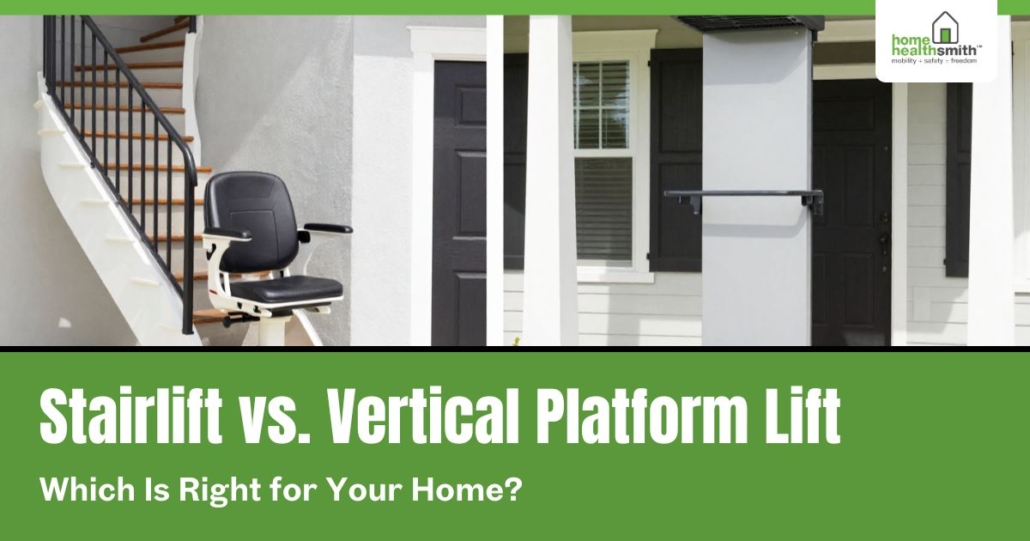
Stairlift vs. Vertical Platform Lift: Which Is Right for Your Home?
When a staircase becomes a barrier, there’s more than one way to remove it. Two of the most practical solutions are stairlifts and vertical platform lifts (VPLs) — and while both solve the problem of getting from one level to another, they do it in completely different ways and suit completely different situations.
If you’re trying to figure out which one is right for a specific home and a specific person, this guide will walk you through exactly what separates them — including cost, installation requirements, who each solution works best for, and the questions our certified specialists ask when they encounter a staircase challenge.
The Short Version: What Each One Does
Stairlift
A stairlift is a motorized chair that travels along a rail mounted directly to your staircase — following the stairs from bottom to top. The user sits in the chair, and the lift carries them up or down the rail. The staircase remains fully accessible for other household members.
Stairlifts work on interior and exterior staircases, can handle straight and curved configurations, and are the most widely used stair mobility solution in residential settings. They are generally the more affordable option and are faster to install.
Vertical Platform Lift (VPL)
A vertical platform lift raises a flat platform straight up and down — like a short-travel elevator — rather than following the slope of a staircase. The user rolls onto the platform (with a wheelchair or walker, or simply standing), and the platform raises them to the next level.
VPLs are typically used for entry-level access — getting into the home over a few front steps, accessing a deck or porch, or bridging the gap between a garage and the main living floor. They can also be used indoors for floor-to-floor travel where a traditional stairlift wouldn’t be appropriate.
The Core Difference: Stair-Following vs. Straight Rise
The most important distinction is geometric: a stairlift follows the angle of your stairs, while a VPL travels straight up and down, independent of any staircase.
This means:
- If the obstacle is an interior staircase — a flight of stairs from the first floor to the second floor — a stairlift is almost always the appropriate solution.
- If the obstacle is a series of steps at an entry point (front steps, deck stairs, garage access) and the user needs to remain in a wheelchair or scooter during the transition, a VPL is usually the better fit.
- If the staircase is too steep, too short, or too unconventionally shaped for a stairlift rail, a VPL may be viable where a stairlift is not.
The single most useful question to ask: Does the person need to transfer out of their wheelchair during this move — or do they need to stay seated throughout? If they can stand and walk short distances, a stairlift may work. If they cannot, a VPL or elevator is more appropriate.
Side-by-Side: Key Differences
Cost
Stairlifts for straight staircases typically range from $3,000 to $5,500 installed. Curved stairlift installations range from $7,000 to $12,000+.
Vertical platform lifts typically range from $4,000 to $9,000 installed depending on the rise height, platform size, and whether the installation is interior or exterior. Outdoor VPLs designed for New England weather conditions sit toward the higher end of that range.
Installation
Stairlifts attach to the stairs themselves — not the walls — using brackets screwed into the stair treads. This means installation is minimally invasive and doesn’t require structural modification to your home. Most straight-stair installations are complete in a few hours.
VPLs require a level surface at both the lower and upper landing, a foundation or concrete pad in some outdoor installations, and electrical access. The installation footprint is more substantial than a stairlift, and exterior VPLs need to be engineered for the load and weather exposure.
Who Can Use It
Stairlifts require the user to be able to sit in the chair, fasten a seatbelt, and operate a simple joystick or button. Most people with standard aging-related mobility challenges — arthritis, joint pain, balance issues, reduced stamina — are good stairlift candidates.
VPLs are the better choice for wheelchair users who need to remain seated, individuals with significant lower-body limitations, or situations where the entry-level obstacle is the primary barrier rather than interior floor-to-floor travel.
Space Requirements
Stairlifts require a usable staircase and fold flat when not in use, leaving the stairs clear for other household members. Narrow staircases (less than 28″ wide) may limit options but rarely eliminate them entirely.
VPLs require a platform area at both levels plus the footprint of the lift mechanism itself. In tight exterior spaces — a narrow front stoop, for instance — installation may require some reconfiguration of the surrounding area.
When a Stairlift Is the Right Choice
- The user can stand briefly to transfer in and out of the stairlift seat
- The obstacle is an interior staircase between floors
- Other family members also use the staircase and need it to remain accessible
- A straight staircase makes a cost-effective straight-rail installation possible
- The home has a curved staircase and a custom-rail solution (like the Harmar Helix) is appropriate
Learn more about our stairlift models, including straight, curved, and outdoor options, on our stairlifts page.
When a Vertical Platform Lift Is the Right Choice
- The user uses a wheelchair or scooter and needs to remain seated throughout the transition
- The obstacle is an entry-level barrier — front steps, a deck, a raised porch, garage access
- The staircase itself is impractical for a stairlift (too steep, too narrow, or too short-travel for a rail)
- A commercial or semi-commercial setting requires ADA-compliant vertical access
- The home has a split-level or raised-ranch layout where a full stairlift isn’t the right fit
Learn more about our vertical platform lift options on our VPL solutions page.
Is There a Third Option?
Yes — and it’s worth mentioning here. If multi-floor access is the central challenge and neither a stairlift nor a VPL fully meets the need, a residential elevator may be the right long-term solution. Elevators are more expensive upfront but offer the most complete access solution, work for wheelchair users without any transfer requirement, and add measurable long-term value to the home.
Our guide on stairlifts vs. residential elevators covers that comparison in detail.
The Most Reliable Way to Know: A Free In-Home Assessment
Every home is different. The photographs and dimensions on your mental map of the house may not capture the features that actually determine which solution is right. That’s why the most reliable way to get a clear answer is to have a certified specialist come to the home.
Home Healthsmith’s SafeHome Audit is a free, no-obligation in-home assessment. Our specialists will evaluate the staircase, the user’s mobility needs, the home’s layout, and the long-term picture — and give you a clear recommendation along with a written estimate.
Not sure which solution fits your home?
Call 401-293-0415 or request a free SafeHome Audit online.
We serve Rhode Island, Massachusetts, and Connecticut. Our specialists will come to you.