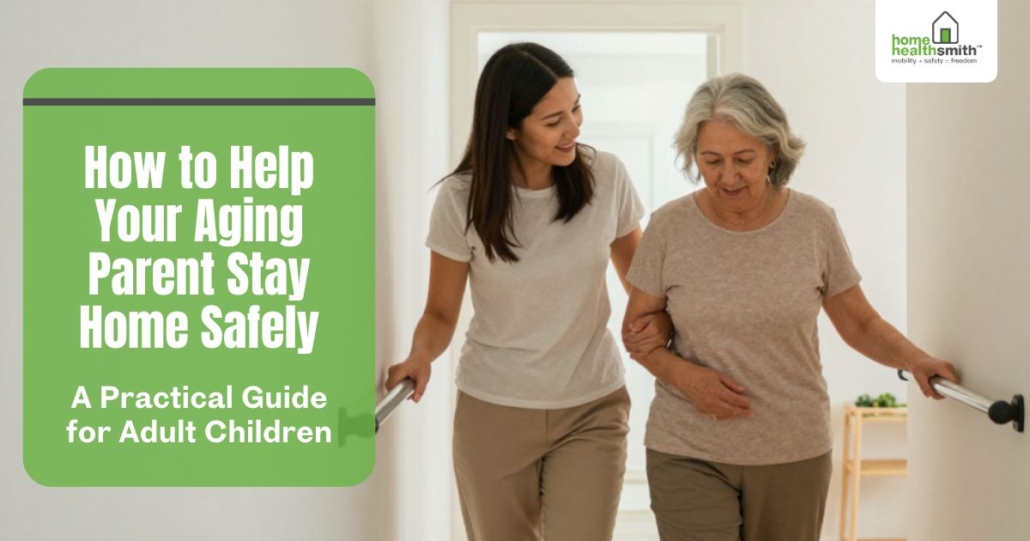
How to Help Your Aging Parent Stay Home Safely: A Practical Guide for Adult Children
You’ve probably been running quiet calculations for a while now. Noticing little things. The way your mom holds the wall on the stairs. The bruise on your dad’s hand from a stumble he mentioned — then quickly changed the subject. The bathroom that you look at with new eyes every time you visit and think: this needs something.
You want to help. You want your parent to be safe. And you also know that this isn’t just a practical problem — it’s an emotional one. The home they live in is the place they’ve built their life. Suggesting changes can feel, to them, like a verdict on their independence.
This guide is for you: the adult child trying to figure out what to actually do, where to start, and how to navigate this with the people you love.
First: Understand What Your Parent Actually Wants
Before you start researching grab bars or stairlifts, the most important step is a conversation. Not about modifications — about values.
Most older adults are not opposed to safety changes when they understand that the goal is continued independence, not a transition out. What they resist — and reasonably so — is feeling managed, rushed, or treated as a problem to solve.
A few questions worth asking:
- “What would need to change for you to feel completely comfortable at home?”
- “Is there anything in the house that worries you?”
- “If something were to happen, what would you want us to do?”
You may be surprised by what they share when the conversation isn’t framed around fear or urgency. And when modifications do become part of the conversation, they’re far more likely to accept — and actually use — solutions they felt they had a voice in choosing.
The Warning Signs Worth Taking Seriously
Not every concern requires immediate action. But some signals genuinely warrant a closer look at the home:
Mobility changes
- Gripping walls, furniture, or railings more than before
- Avoiding stairs or certain rooms
- Slower movement on stairs, or pausing mid-flight
- Difficulty rising from chairs or the toilet
Falls or near-misses
- Any fall — even one that seems minor — is a serious indicator that something in the home’s safety profile has changed
- Unexplained bruises, especially on arms or hips
- Admission that they’ve “almost fallen” more than once
Bathroom avoidance
This one is subtle but important. Older adults who are afraid of the bathroom — of slipping in the shower, of struggling to rise from the toilet — will sometimes unconsciously reduce how often they use it. If you notice changes in hygiene or routine, bathroom safety is worth examining.
Changes in medication or health
New medications that affect balance or blood pressure, a recent hospitalization, a new diagnosis of Parkinson’s, arthritis, COPD, or dementia — any of these shift the risk profile of an existing home, sometimes significantly.
Falls are the leading cause of fatal and nonfatal injuries in adults 65 and older, according to the CDC. Each prevented fall saves an average of $30,000 in hospital and rehabilitation costs — a number that reframes the cost of home modifications considerably.
The Highest-Impact Home Modifications
Not all modifications are equal in terms of impact. These are the areas where the risk is highest and the changes make the biggest measurable difference:
Bathroom
The bathroom is where the majority of serious home falls occur. The combination of hard surfaces, water, and frequent position changes (standing, bending, sitting, rising) creates real risk. Priority modifications include:
- Grab bars — professionally installed, anchored to studs, and positioned at the correct height for the individual. Not suction-cup bars from a home goods store. Medical-grade, load-tested bars installed by someone who knows what they’re doing.
- A walk-in shower or tub with a low or no threshold, eliminating the step-over risk
- Non-slip flooring or strips, particularly in the shower and in front of the toilet
- A raised toilet seat or toilet safety frame to make rising easier
See our bathroom safety products for solutions our team installs across Rhode Island, Massachusetts, and Connecticut.
Stairs
If your parent lives in a multi-story home, stair access is a central question. Handrails on both sides are the minimum. For a parent who is struggling with stairs now, a stairlift is worth serious consideration before a fall happens — not after.
Our stairlift options page covers straight, curved, and outdoor models. If you’re not sure what type of staircase your parent has, a free in-home assessment is the fastest way to find out.
Entryways and Exterior
Front steps, thresholds, and outdoor pathways are where many falls happen outside the house. A wheelchair ramp, a vertical platform lift for a raised porch, or even a simple threshold ramp can eliminate daily risk at the entry point.
Lighting
Inadequate lighting is a factor in a significant proportion of home falls — and it’s one of the easiest and least expensive things to fix. Motion-activated night lights along the path from bedroom to bathroom, and at the top and bottom of stairs, should be non-negotiable.
The Hardest Part: Starting the Conversation
For many adult children, this is the real obstacle. Not the logistics. Not the cost. The conversation.
A few principles that tend to make these conversations go better:
- Lead with love, not fear. “I want you to be able to stay in this house for the rest of your life” lands differently than “I’m scared something is going to happen.”
- Make it collaborative. “Can we look at this together?” instead of “We need to talk about the bathroom.”
- Start with the least threatening thing. A grab bar or a night light is a much easier entry point than “we need to talk about a stairlift.”
- Bring in a neutral expert. Sometimes a parent who resists a child’s concern will respond differently to a certified specialist. Our SafeHome Audit is specifically designed to be a professional, non-threatening assessment — not a sales visit.
A Note on Dementia and Cognitive Change
If your parent has been diagnosed with dementia or is showing early signs of cognitive decline, home safety takes on an additional dimension. The risks are different, the modifications are different, and the emotional complexity is significant.
Linda Bohmbach, HHS’s Integrator and co-owner, is a Certified Dementia Practitioner — a credential that informs how our team approaches assessments for families navigating this specific situation. A SafeHome Audit for a parent with dementia will look at different risks than one for a parent dealing primarily with mobility challenges.
You Don’t Have to Figure This Out Alone
The decisions you’re facing — what modifications to make, in what order, at what cost, with what impact on your parent’s sense of independence — are genuinely complex. They’re not problems you can solve with a single Google search.
Home Healthsmith has helped more than 5,000 families across Rhode Island, Massachusetts, and Connecticut navigate exactly this process. Our certified specialists have spent decades inside homes like your parent’s, talking to families like yours, and helping people build a path forward that keeps everyone safe without taking away what matters most.
The first step is the SafeHome Audit — a free, no-obligation in-home assessment that gives you a clear picture of what the home needs, what it doesn’t, and what the options are. It starts at the driveway and ends with a written report.
Ready to start? We’re here.
Call 401-293-0415 or email info@homehealthsmith.com to schedule a free SafeHome Audit.
We serve all of Rhode Island, Massachusetts, and Connecticut — and we’ll come to you.