How Much Does a Vertical Platform Lift Cost?
💡Direct answer
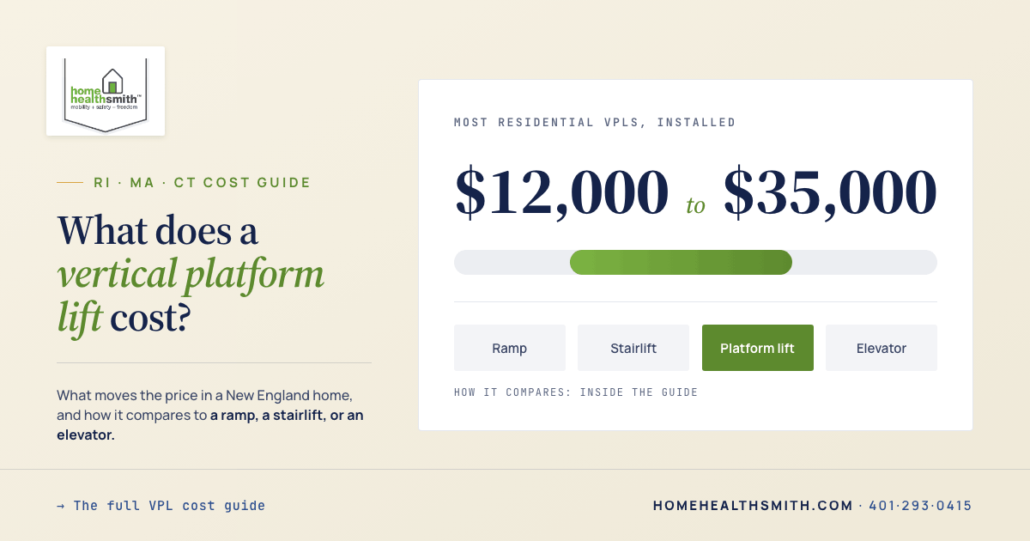
A professionally installed residential vertical platform lift typically costs somewhere between about $12,000 and $35,000, with most straightforward outdoor porch or entry installations toward the lower end of that range. Where your project lands depends mainly on how high the lift has to travel, whether it goes indoors or outdoors, and how much site work the home needs. At Home Healthsmith, a Harmar factory-trained installer serving Rhode Island, Massachusetts, and Connecticut, we give every family a firm written price after a free in-home assessment, so permits, site work, and installation are in the number from the start.
What is a vertical platform lift, and who is it for?
A vertical platform lift (VPL), sometimes called a porch lift or wheelchair lift, raises a person straight up on a level platform while they stay seated in their wheelchair, power chair, or scooter. There’s no transfer to a seat, which is the main reason families choose one over a stairlift.
Most residential VPLs solve a short rise: the steps up to a front door or porch, a deck, a garage entry, or a split-level change inside the home. For travel between full floors, a residential elevator is usually the better fit.
Home Healthsmith has installed accessibility equipment in New England homes for more than 45 years. We’re part of LiftSquad, Harmar’s factory-trained and certified installation network, and our platform lift options include Harmar’s Highlander lifts and Serenity residential lifts.
What affects the cost of a vertical platform lift?
How high the lift travels
Rise height is the biggest single factor in the equipment price. A lift that covers three or four entry steps is a very different machine from one that carries someone up to a raised first floor or a second-story deck. Taller lifts need taller towers, more structure, and often added safety features like enclosures or gates.
Indoors or outdoors
Outdoor porch and entry installations are the most common and usually the least expensive. An indoor lift often costs more because the space around it may need framing, an enclosure, or a dedicated shaft-like area, which means construction work alongside the lift itself.
Site preparation
This is where two lifts of the same model can end up priced very differently. An outdoor lift usually needs a level concrete pad. The project may also involve modifying a deck or porch, adjusting or rebuilding steps, widening a doorway, or adding a landing at the top. In older New England homes with granite steps, sloped lots, or tight side entrances, site prep is often the deciding factor.
Electrical and power options
Lifts need a dedicated electrical connection. Some models can be specified with battery (DC) power instead of, or alongside, standard household (AC) power, so the lift keeps working during an outage. That option adds cost but can be well worth it for a home that loses power often.
Gates, enclosures, and upgrades
Depending on the height and the setting, a lift may need landing gates, a partial or full enclosure, a larger platform, call-and-send controls at each landing, or a wireless remote. Some platforms can be set up for a 90-degree exit when the door is on a different side from the entry. Each of these adds to the base price, and each is chosen to fit how the person will actually use the lift.
Permits and inspections
Platform lifts are regulated equipment. In Massachusetts, for example, a lift has to pass state inspection before it can be used. Permit and inspection costs are modest compared with the project, but they’re real, and an installer who handles them should include them in the quote.
“Dear Bill and Linda: … He listened to my concerns and came up with a solution to provide a lift to take us up 10 feet to our raised home entrance. The project met all the requirements for elevator inspection with the Massachusetts elevator inspectors office… Linda as project manager provided all the technical documentation for the State regulations.”
— Colby R., Mattapoisett, MA
Why are online prices so much lower than installer quotes?
Because they usually aren’t the same thing. A price listed online is often for the equipment alone. It typically doesn’t include delivery, the concrete pad, deck or step work, electrical, permits, inspection, installation labor, or anyone to call when the lift needs service.
There’s also the warranty to think about. Manufacturers generally require installation by a trained, authorized dealer, and an installation done by a LiftSquad technician protects the Harmar warranty. A lift installed by someone who isn’t trained on it can leave a family with equipment nobody will stand behind.
“When a family shows me a lower number they found online, the first thing I do is list everything that number leaves out. Usually it’s the pad, the electrician, the permit, the inspection, and the next ten years of service. We’d rather give you one honest number up front, with all of that in it, than a low one that grows. And if a ramp or a stairlift will do the job for less, we’ll tell you that too.”
— Bill Bohmbach, CEO, Home Healthsmith. Certified Aging-in-Place Specialist; Executive Certificate for Home Modification. [DRAFT — confirm with Bill before publishing]
How does a platform lift compare in cost to a ramp, stairlift, or elevator?
- Wheelchair ramp: often less expensive for a small rise, but ramps need a lot of space. Code-compliant slope means roughly a foot of ramp for every inch of rise, so a few steps can turn into dozens of feet of ramp. On many New England lots, there simply isn’t room, and a long ramp is hard to keep clear of ice.
- Stairlift: usually less expensive than a platform lift, but it requires the person to transfer out of the wheelchair onto a seat, and the chair still has to get up the stairs another way.
- Residential elevator: typically the most expensive option, often several times the cost of a platform lift, but the right answer for travel between full floors.
For someone who uses a wheelchair full time and needs to get up a porch, a deck, or a short interior rise, the platform lift is often the most practical and cost-effective answer.
“We are very happy with the Vertical Passport Lift. The company was very quick to call me back and Linda was great to work with. Very courteous and thorough and customer service was wonderful and call backs were very prompt.”
— Mento Family, Providence, RI
Are there ways to help pay for a vertical platform lift?
Sometimes. Standard Medicare generally doesn’t cover platform lifts because they’re treated as home modifications. Some Medicaid waiver programs in Rhode Island, Massachusetts, and Connecticut include home modification benefits for eligible individuals, and veterans with service-connected disabilities may qualify for VA housing grants. Our financing guide walks through the options in detail.
What should a vertical platform lift quote include?
When you compare quotes, make sure each one covers the same things:
- The lift model, rise height, and platform size.
- Site work: pad, deck or step modifications, and any doorway changes.
- Electrical work and power options, including battery backup if you want it.
- Gates, enclosure, and controls.
- Permits and inspections.
- Installation, a demonstration for the household, and warranty on parts and labor.
- Who services the lift afterward, and how quickly they respond.
Frequently asked questions
How long does it take to install a vertical platform lift?
The lift itself usually goes in quickly once the site is ready. The overall timeline depends mostly on site work and permitting, such as pouring a pad or modifying a porch, and on inspection scheduling in your state. We’ll give you a realistic timeline with your quote.
Will an outdoor platform lift work in a New England winter?
Yes. Outdoor lifts are built for the weather, and options like cold-weather packages and covers can help in harsher spots. Like any outdoor entry, the platform and path need to be kept clear of snow and ice, and regular maintenance keeps everything running reliably through the season.
Does a vertical platform lift need maintenance?
Yes, though usually not much. A periodic service visit checks the drive, safety sensors, gates, and controls. Our SafeHome Advantage program builds that into an ongoing relationship, so the lift is looked after without you having to remember it.
Can I see a platform lift before I buy one?
Yes. Visit our Accessibility Living Suite showroom in Portsmouth, RI to see accessibility equipment in person, ask questions, and get a feel for how it works before anything is installed at home.
Is a platform lift the same as a home elevator?
No. A platform lift is a simpler machine designed for shorter rises, usually with an open or partially enclosed platform and constant-pressure controls. A residential elevator has an enclosed cab and is built for travel between full floors. We can help you decide which one your home actually needs.
The next step
The fastest way to a real number is to have the entry measured and the site looked at in person. In one visit, we can tell you whether a platform lift is the right answer, what your installation would involve, and what it would cost in writing.
📞 Schedule a free SafeHome Audit
A Home Healthsmith specialist will measure the rise, look at the site, and give you a written price that includes permits, site work, and installation — or tell you honestly if a ramp or stairlift would serve you better. No cost, no obligation, no pressure.
Call (401) 293-0415 or request your SafeHome Audit online.
Serving Rhode Island, Massachusetts, and Connecticut. Showroom: the Accessibility Living Suite, 207 Highpoint Ave., Ste 2, Portsmouth, RI.