
Curved vs. Straight Stairlifts: Which One Does Your Staircase Need?
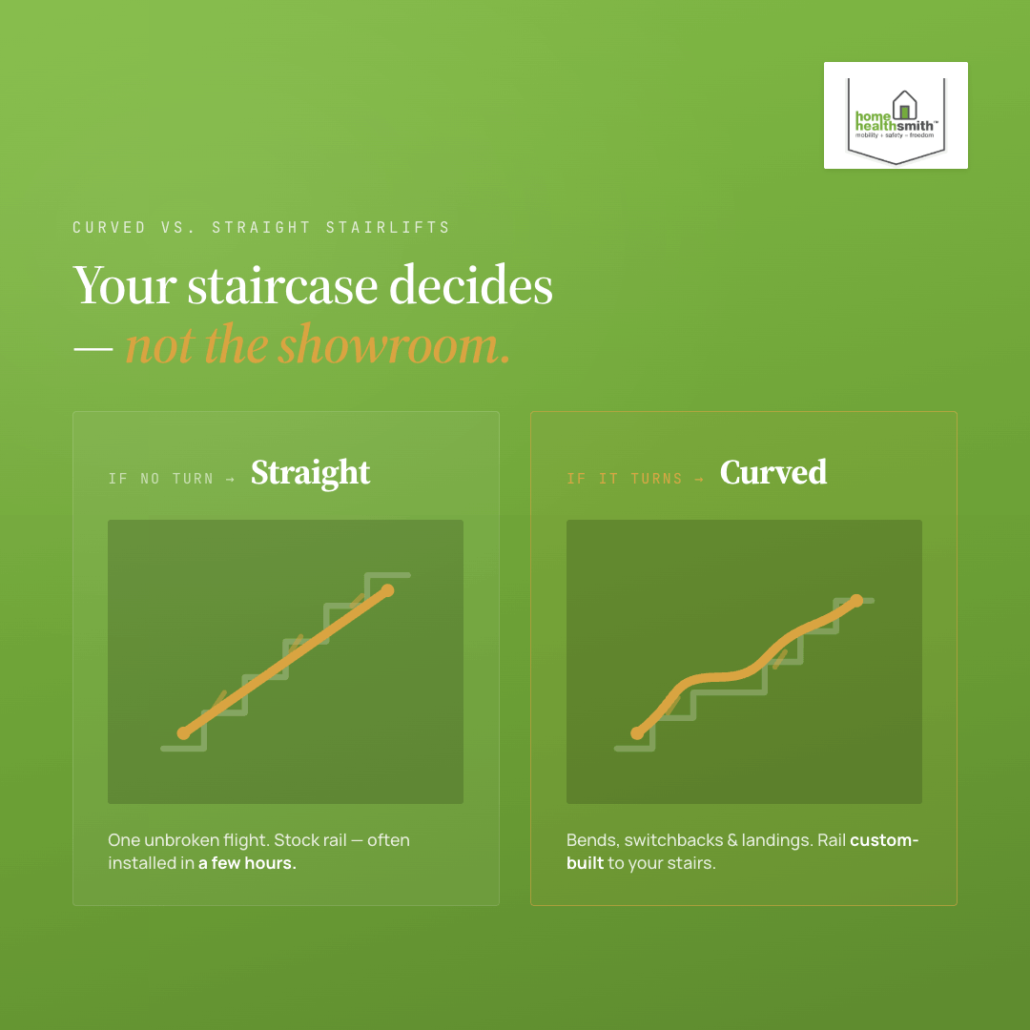
The difference comes down to the shape of your stairs. A straight stairlift runs along a single, unbroken flight and can often be installed in a matter of hours. A curved stairlift is custom-built to follow a staircase that bends, turns, or pauses at a landing. If your stairs run straight from bottom to top, you need a straight model. If they curve, switch back, or include a landing — which is common in older New England homes — you need a curved one.
Home Healthsmith has been designing and installing stairlifts for families across Rhode Island, Massachusetts, and Connecticut for more than 45 years. We install both straight and curved models from trusted manufacturers — including Bruno, Harmar, Hawle, and Handicare — which means our recommendation is based on what your staircase and your body actually need, not on the one product a company happens to sell.
What’s the actual difference between a curved and a straight stairlift?
A straight stairlift uses a standard, pre-made rail that mounts directly to your stair treads along one continuous flight. Because the rail is not custom-fabricated, installation is faster and the cost is lower. The Bruno Elan is a popular straight model — its controls sit right on the armrest, the rail mounts close to the wall to keep the stairway open, and it includes a swivel seat for safer transfers at the top.
A curved stairlift is engineered for your specific staircase. The rail is custom-bent to follow every turn, landing, or spiral. Harmar’s Helix curved stairlift, for example, is measured with a calibrated camera kit for digital accuracy, then built with precision-bent steel rails finished by hand. That customization is what allows a curved lift to hug tight bends and carry you smoothly around a corner instead of stopping at a landing.
How do I know which one my staircase needs?
Walk your stairs and ask one question: do they turn at any point? If the answer is no — the stairs go straight up with no bend and no landing — a straight stairlift will fit. If the answer is yes — there’s a 90-degree turn, a switchback, a mid-flight landing, or a curve — you need a curved model designed to follow that path.
It can be tempting to force a cheaper straight lift onto stairs that turn by stopping at the landing and transferring to a second lift. That works in some homes, but it means standing, walking across the landing, and sitting again — exactly the kind of transfer many people are trying to avoid. For most curved staircases, a single custom curved lift is both safer and more comfortable.
“The staircase tells us what to install — not the other way around. We measure first, every time. When someone tries to save money by putting a straight lift on stairs that turn, the savings usually disappear the first time they have to get up and walk across a landing mid-trip. The right fit is the one that removes the transfer, not the one that adds another.” — Bill Bohmbach, CEO and Certified Aging-in-Place Specialist, Home Healthsmith
Why do curved stairlifts cost more — and when are they worth it?
Curved stairlifts cost more because each rail is custom-manufactured for one staircase and one home. There’s precise measurement, fabrication, and a longer lead time before installation. A straight stairlift, by contrast, uses a stock rail cut to length on site.
The cost difference is real, but so is the value. A curved lift is worth the investment when it lets someone reach their bedroom, bathroom, or main living area without a single risky transfer. For a multi-story home where the only full bathroom is upstairs, that’s not a luxury — it’s what keeps someone living independently in the home they love.
Are curved stairlifts common in older New England homes?
Yes. Many historic homes across Rhode Island, Massachusetts, and Connecticut were built with turned staircases, narrow flights, and mid-level landings — the exact layouts that call for a curved lift. These homes weren’t designed with mobility in mind, but they can almost always accommodate a custom curved stairlift.
Because we install several curved-capable brands, we can match the lift to the quirks of an older home: tight bends, steep pitches, and narrow widths. Hawle’s lifts, for instance, are designed even for steep stairs with a gradient as severe as 75 degrees.
Can a stairlift go outside on curved porch or deck steps?
It can. Both straight and curved outdoor stairlifts are available and built to withstand New England weather. Harmar’s outdoor curved models are custom-made for the specific set of steps and come with weatherproof covers to protect the unit year-round. If front steps, a back deck, or a sloped entry is the barrier, an outdoor stairlift can restore safe access in and out of the home.
What do both types have in common?
Whether straight or curved, the stairlifts we install share the safety and convenience features that matter most: a battery backup so the lift keeps working during a power outage, a fold-up seat and footplate to keep the stairs clear for other people in the house, a swivel seat for safer exits at the top, safety sensors that stop the lift if something is in its path, and two remote controls so the lift can be called to either end of the stairs.
Frequently Asked Questions
Can I put a straight stairlift on a curved staircase? Not directly. The workaround is to install two straight lifts with a transfer at the landing, but that reintroduces the standing-and-walking step many people are trying to eliminate. For most turning staircases, a single custom curved lift is the safer, more comfortable choice.
How long does installation take for each? A straight stairlift can often be installed in a few hours because it uses a stock rail. A curved stairlift requires custom rail fabrication first, so there’s a longer lead time before the install day — though the installation itself is still quick once the rail arrives.
Can a stairlift be removed or reused later? A straight stairlift is relatively easy to remove and, in some cases, reuse on a similar staircase. A curved lift is custom-built to one staircase, so it’s less likely to transfer to another home — something worth weighing if the need may be temporary. If it is temporary, ask us about renting instead of buying.
Do stairlifts work during a power outage? Yes. The stairlifts we install include a battery backup system that keeps the lift running during an outage — an important feature in New England, where winter storms can knock out power for hours or days.
| Not sure whether your stairs are straight or curved? Let us measure.
A free SafeHome Audit includes a professional look at your staircase, so you get a clear answer — and an honest recommendation — before you spend a dollar. We serve Rhode Island, Massachusetts, and Connecticut. Call (401) 293-0415 or schedule your SafeHome Audit at homehealthsmith.com/services/safehome-audit/. |
Learn more: Stairlifts at Home Healthsmith · Home Stairlifts: Products and Installation · The SafeHome Audit