
How Long Does a Stairlift Last? Maintenance, Lifespan, and When to Replace
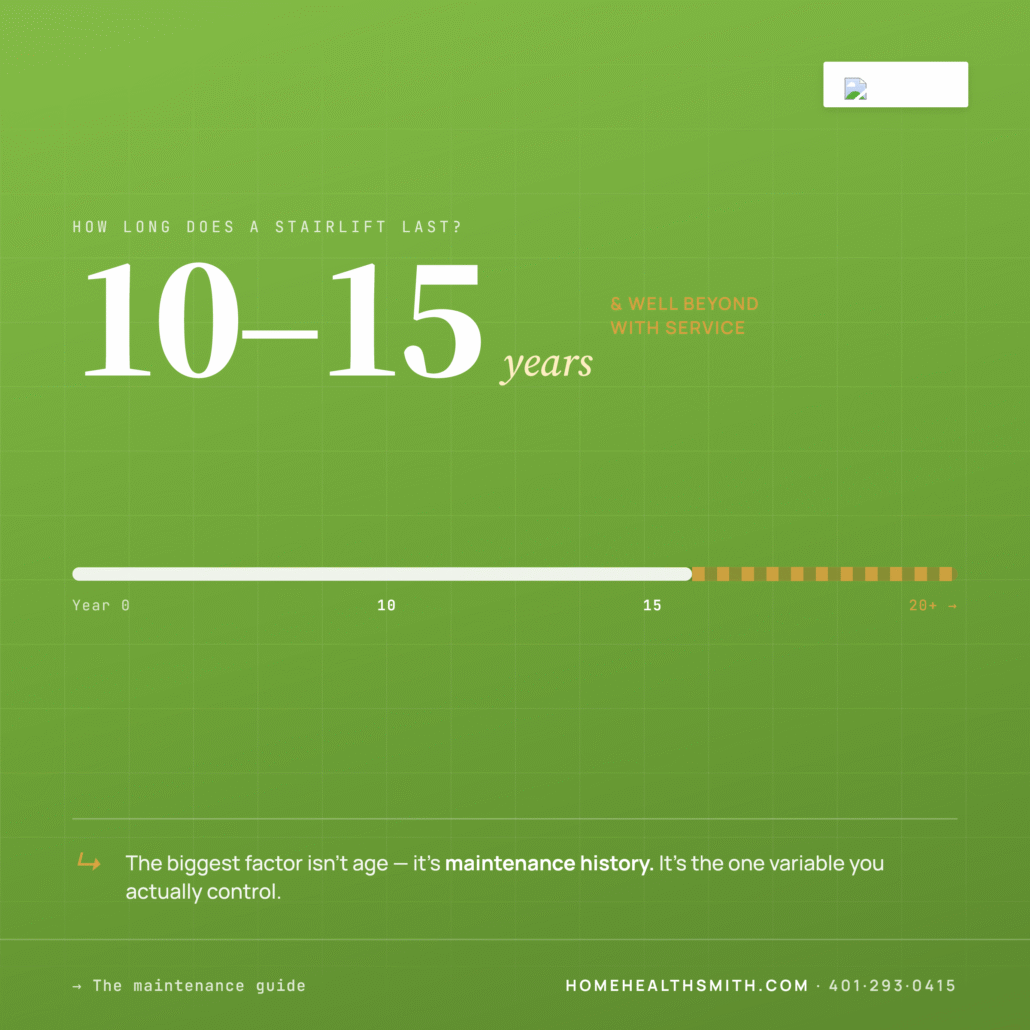
A well-maintained stairlift typically lasts between 10 and 15 years, and many units remain fully functional well beyond that with regular servicing. The biggest factors are usage frequency, the quality of the original installation, and whether the lift receives scheduled maintenance — not just repairs when something goes wrong. At Home Health Smith, which has been installing and servicing stairlifts in Rhode Island, Massachusetts, and Connecticut for over 45 years, the lifts that hold up longest are almost always the ones with a consistent maintenance history.
How long do stairlifts typically last?
The industry standard lifespan for a residential stairlift is 10 to 15 years for straight-rail models and a similar range for curved units — though curved stairlifts tend to require slightly more maintenance because their custom-bent rails are subject to more mechanical complexity over time.
That said, lifespan isn’t a fixed number. A stairlift used daily by one person weighing 150 pounds in a climate-controlled home will age very differently than one used multiple times per day, installed outdoors, or carrying maximum weight loads. Usage intensity, environment, and installation quality all matter.
Outdoor stairlifts — like the Aviator units Home Health Smith installs for porches, decks, and front entries — are engineered to withstand New England weather conditions, but they do require more frequent attention than indoor models given the exposure to moisture, temperature swings, and seasonal debris.
What factors affect how long a stairlift lasts?
Several variables determine how much use you’ll get from a stairlift before it needs significant repair or replacement:
- Installation quality: A stairlift mounted on a properly measured, well-secured rail — with correct tension and alignment — will outlast one installed without that precision. This is one reason professional installation by a certified specialist matters from day one.
- Usage frequency: A lift used twice a day ages more slowly than one making 10 or 12 trips daily. For high-use households, more frequent servicing intervals are appropriate.
- Weight load: Running a stairlift consistently at or near its rated weight capacity accelerates wear on the drive system and rail. Standard models typically support 300–350 lbs; heavy-duty models (like the Harmar 600HD) are designed for higher loads and should be specified when appropriate.
- Environment: Indoor stairlifts in temperature-stable homes experience less mechanical stress than outdoor units or those in humid environments like a lakehouse or coastal property. Humidity and salt air accelerate corrosion in metal components.
- Maintenance history: This is the most controllable variable. Stairlifts with scheduled inspections — where lubrication is maintained, worn components are caught early, and the rail is kept clean and aligned — simply last longer and fail less often.
What does stairlift maintenance actually involve?
Routine stairlift maintenance is less about responding to problems and more about preventing them. A thorough service visit typically covers:
- Lubricating the rail and drive mechanism
- Inspecting and testing all safety sensors
- Checking the battery backup system
- Testing the swivel seat and footplate operation
- Inspecting the drive belt or rack-and-pinion system for wear
- Checking all electrical connections
- Testing the joystick and remote controls
- Inspecting the fold mechanism and seat belt
The goal isn’t just to confirm that the lift works today — it’s to catch wear before it becomes failure. A worn drive belt, for example, is a straightforward replacement during a scheduled visit. The same problem discovered when the lift stops working mid-staircase is a more disruptive and expensive repair.
| 📋 What Home Health Smith’s SafeHome Advantage covers
The SafeHome Advantage program includes a home safety audit every four months — conducted by a trained Home Health Smith technician. Every visit includes a review of all installed equipment (stairlifts, elevators, platform lifts, and other accessibility products), plus a broader safety walkthrough covering everything from grab bar security to lighting. Members also receive discounted access to community resources and ongoing support from the Home Health Smith team. Most stairlift problems that require costly repair are preceded by warning signs a trained technician will catch during routine service — before they become urgent. |
How often should a stairlift be serviced?
For residential stairlifts in normal use, an annual service visit is the standard recommendation. High-use stairlifts — those making 8 or more trips per day — benefit from a semi-annual schedule. Outdoor stairlifts in New England should be serviced at minimum twice a year: once before winter and once after, to address seasonal wear.
Some manufacturers also offer extended warranties contingent on documented annual service, so there can be a financial benefit to maintaining a service record beyond the operational one.
How do you know when it’s time to repair vs. replace?
This is the question most families face after 8 to 10 years with a stairlift, and the answer depends on a few honest assessments:
Repair is typically the right choice when: the lift is under 10 years old, the problem is isolated (a single sensor, a worn component, a battery replacement), and the overall mechanical condition of the unit is sound. Most routine repairs cost a fraction of replacement.
Replacement is worth considering when: the lift is past 12–15 years old, multiple systems are failing simultaneously, replacement parts are becoming scarce for the model, or the user’s mobility needs have changed significantly enough that a different product configuration would serve them better.
The gray zone: A lift that’s 10–12 years old with one significant failure is genuinely ambiguous. A technician who has serviced the unit and knows its history is the right person to give an honest assessment — not a general estimate from someone seeing it for the first time.
Bill Bohmbach, Home Health Smith’s CEO and Certified Aging-in-Place Specialist, puts it this way: “We’d rather tell a family that their stairlift has five good years left with a repair than sell them something they don’t need yet. But we also don’t want to put good money into a unit that’s on its last legs. The right answer is always honest.”
What are the warning signs that a stairlift needs attention?
These symptoms indicate it’s time to schedule a service visit:
- Unusual grinding, clicking, or humming sounds during operation
- Hesitation or jerking motion — the lift doesn’t start or stop smoothly
- The lift stops partway up and needs to be restarted
- Remote controls becoming less reliable or requiring multiple presses
- The seat or footplate folding mechanism feels stiff or doesn’t latch correctly
- The battery backup indicator showing reduced charge retention
- Any visible corrosion on the rail, especially in outdoor or humid environments
None of these individually mean the stairlift is failing — but any of them are the right prompt to call for a service visit rather than wait for the next scheduled one.
Does Home Health Smith service stairlifts it didn’t install?
Yes. Home Health Smith services stairlifts and other accessibility equipment throughout Rhode Island, Massachusetts, and Connecticut regardless of where the original installation was performed. If you’ve moved into a home with an existing stairlift, inherited equipment after a family member passed, or had a stairlift installed by another company, we can assess the unit, provide a service history going forward, and enroll it in the SafeHome Advantage program.
For older equipment or less common brands, we’ll give you an honest evaluation of whether the unit is worth maintaining or whether replacement is the more practical path.
Frequently Asked Questions
How much does stairlift maintenance cost? A routine annual service visit for a straight stairlift typically runs $100–$200, depending on what the technician finds. Curved models and outdoor units tend to run slightly higher due to increased mechanical complexity. Most repairs — replacing a sensor, a battery pack, or a drive belt — are in the $150–$400 range. Full replacement of major drive components is less common and more expensive, which is why catching wear early through scheduled maintenance has real financial value.
What’s the difference between a warranty repair and a maintenance service? A warranty repair covers defects in materials or workmanship — problems that are the manufacturer’s or installer’s responsibility under the warranty terms. A maintenance service is proactive, scheduled upkeep that keeps the lift functioning reliably between warranty claims. Maintenance often preserves warranty coverage: some manufacturers require documented annual service to keep extended warranties valid. Home Health Smith follows up at six and twelve months post-installation as standard, and the SafeHome Advantage program extends that support on an ongoing basis.
Can I perform stairlift maintenance myself? Basic cleaning — wiping down the rail, keeping the track clear of dust and debris, ensuring the area around the lift stays dry — is appropriate for homeowners to handle. Lubrication, mechanical inspection, and electrical testing should be done by a trained technician. Incorrect lubrication of the drive system can actually accelerate wear rather than prevent it, and safety sensor calibration requires equipment and training that isn’t practical for a DIY approach.
Does a stairlift rental need maintenance too? Yes — all stairlifts require maintenance regardless of whether they’re owned or rented. If you’re renting a stairlift through Home Health Smith, maintenance is included as part of the rental arrangement. This is one of the practical advantages of renting through a local provider rather than a national company: when something needs attention, you’re calling someone who knows your home and your equipment.
What happens to a stairlift during a power outage? All stairlifts that Home Health Smith installs include a battery backup system that allows the lift to continue operating during a power outage. The Harmar Pinnacle, for example, can perform as many as 60 cycles on battery power. This is an important safety feature in New England, where extended outages from winter storms are a real possibility. The battery backup system is tested during every service visit to confirm it’s holding an adequate charge.
| 🔧 Schedule a service visit or SafeHome Advantage enrollment
If your stairlift is due for service — or if you’re not sure when it was last serviced — Home Health Smith can help. We serve Rhode Island, Massachusetts, and Connecticut. Call (401) 293-0415 or schedule online at homehealthsmith.com/contact-us/. |
Learn more: Stairlifts at Home Health Smith · The SafeHome Advantage · Stairlift Cost in Rhode Island and Massachusetts