
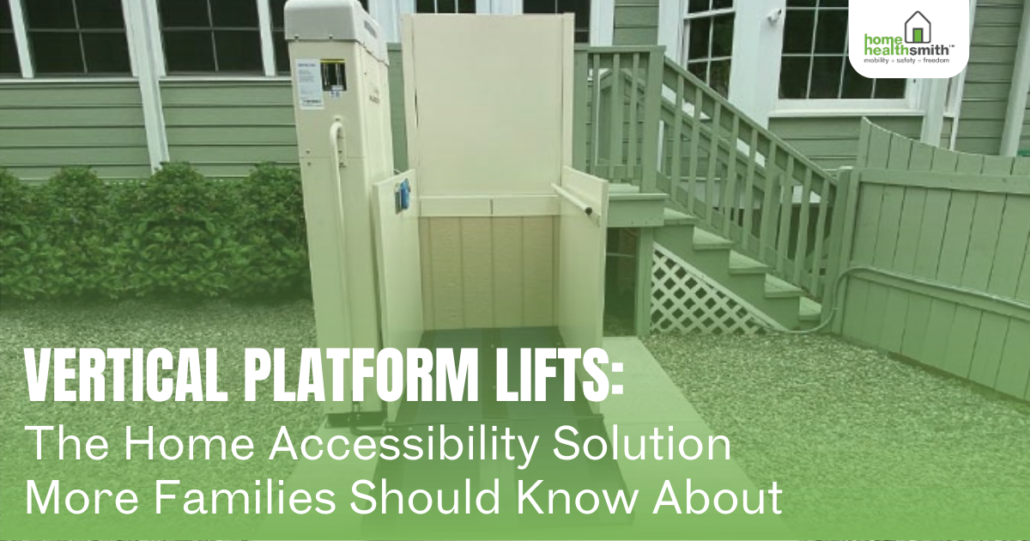
Vertical Platform Lifts: The Home Accessibility Solution More Families Should Know About
When families start thinking about accessibility modifications, their minds usually go to two places: stairlifts and wheelchair ramps. Both are excellent solutions for the right situation. But there’s a third option that often gets overlooked—one that solves problems neither a ramp nor a stairlift can—and that’s the vertical platform lift (VPL).
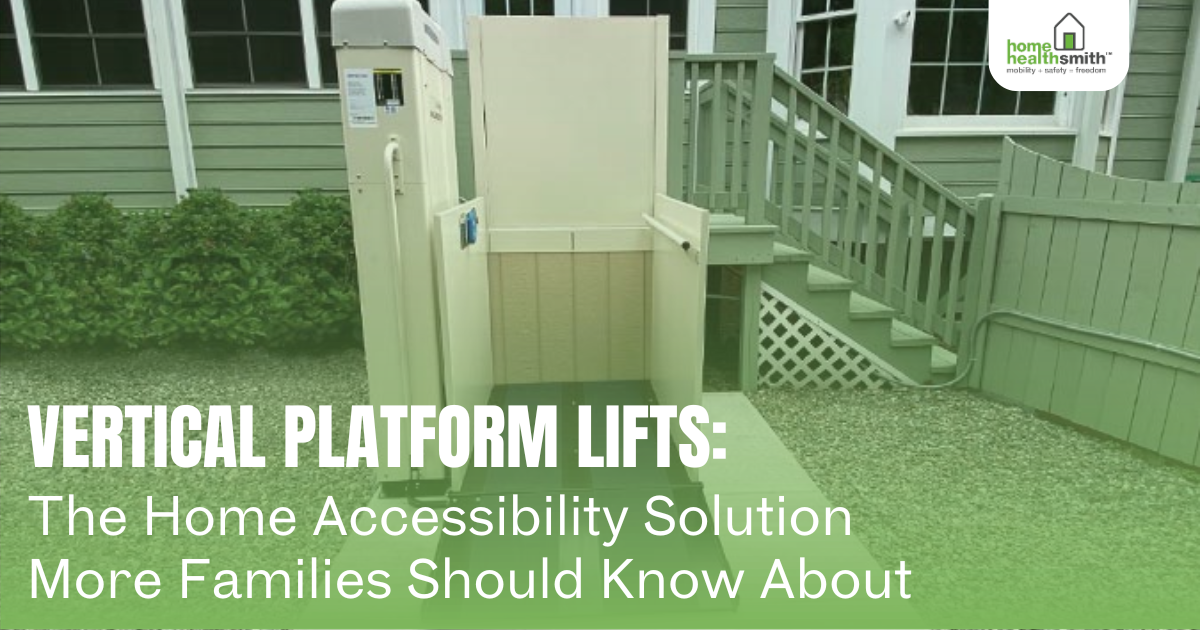
Also known as a porch lift or wheelchair lift, a VPL is essentially a small platform that raises and lowers a person vertically between two levels. Think of it as a compact, open elevator. If your parent uses a wheelchair, power chair, or scooter and needs to get from ground level to a porch, deck, or raised entryway, a vertical platform lift may be the most practical solution available.
How Vertical Platform Lifts Work
A vertical platform lift operates on a simple principle: a flat platform moves straight up and down along a vertical track, powered by an electric motor. The user rolls onto the platform in their wheelchair or mobility device, presses a button (or a caregiver uses a remote control), and the platform smoothly raises or lowers them to the desired level.
Modern VPLs come with multiple safety features including non-slip platform surfaces, automatic stops if an obstruction is detected, safety gates or barriers at each landing, and emergency battery backup systems that allow the lift to operate even during a power outage. The models we install at Home Healthsmith, including the Harmar Highlander II, are built with 24V battery systems that can complete up to 30 fully loaded cycles without AC power—an important consideration during New England winter storms.
When a Vertical Platform Lift Makes More Sense Than a Ramp
Ramps are a great solution in many situations. But they have a fundamental limitation: wheelchair ramp installation requires one foot of ramp for every inch of rise to meet ADA guidelines. That means a home with just five steps (roughly 35 inches of rise) would need a ramp at least 35 feet long—plus landing platforms at turns. Seven steps? You’re looking at about 50 feet of ramp.
For many New England homes, especially those on smaller lots or with limited yard space, that just isn’t feasible. A vertical platform lift, by contrast, requires roughly a 5-by-5-foot footprint. It can be installed against the side of a porch, in a garage, or along a home’s exterior without consuming your entire front yard.
A VPL is also the stronger option when the elevation change is significant (typically three or more steps), when the user has limited upper body strength to navigate a long ramp incline, when space is tight and a code-compliant ramp simply won’t fit, or when outdoor weather conditions make ramp use hazardous—snow and ice on a 40-foot ramp is a real safety concern in Rhode Island, Massachusetts, and Connecticut.
Vertical Platform Lifts vs. Stairlifts: Understanding the Difference
If you’ve been comparing mobility solutions, it helps to understand where a VPL fits relative to a stairlift. Stairlifts are designed for individuals who can sit down and stand up from a chair but have difficulty climbing stairs. They transport the person along the staircase rail—but they don’t transport the person’s wheelchair or mobility device with them.
A vertical platform lift, on the other hand, moves the person and their mobility device together. This is a critical distinction. If your parent relies on a wheelchair, power chair, or scooter full-time and can’t safely transfer to and from a stairlift seat, a VPL is likely the better choice. There’s no need to keep a second wheelchair on another level, and no risk involved in transferring between devices.
That said, stairlifts remain the ideal solution for many people—particularly those who walk with a cane or walker and just need help on the stairs. The right answer depends entirely on the individual’s mobility needs. If you’re not sure which direction to go, our team can evaluate the situation during a free SafeHome Audit and recommend the best fit.
Indoor and Outdoor Applications
One of the things that makes VPLs so versatile is that they work both indoors and outdoors. Outdoor installations are the most common—getting from ground level up to a porch, deck, or raised entryway—but indoor VPLs can be used to navigate split-level homes or access a finished basement.
Garage installations have become increasingly popular as well. By placing the VPL inside a garage, the user is protected from weather when entering and leaving the home, and the lift doesn’t affect the home’s curb appeal. Some homeowners who are concerned about how modifications look from the street—a consideration we discuss in our guide to how accessibility products affect home value—find that a garage-based VPL offers the best of both worlds.
For outdoor installations, material matters. The models we carry feature durable aluminum construction that’s waterproof and rust-resistant—qualities that make a significant difference in the wet, salty, freeze-thaw conditions common across New England. Steel units, by contrast, can corrode over time when exposed to the elements.
What to Expect: Cost, Installation, and Maintenance
Vertical platform lifts typically fall between stairlifts and residential elevators in terms of cost. Pricing depends on the model, the height of travel, whether the installation is indoor or outdoor, and any site-specific factors like electrical work or platform construction. Generally, a residential VPL costs less than a home elevator while offering many of the same benefits for shorter vertical distances.
Installation is straightforward compared to an elevator. There’s no need for a shaft, machine room, or major structural modifications. A qualified installer can typically complete the job in one to two days, depending on the complexity of the site. At Home Healthsmith, all of our VPL installations are performed by factory-trained, LiftSquad-certified technicians who are fully licensed and insured.
Ongoing maintenance is minimal—typically an annual inspection and occasional lubrication of moving parts. If you’re enrolled in our SafeHome Advantage program, scheduled maintenance is built right in.
Is a Vertical Platform Lift Right for Your Family?
A VPL could be the right solution if your loved one uses a wheelchair, power chair, or scooter and needs to access a raised entry, porch, or deck. It’s worth a serious look if a ramp won’t fit the available space, if the elevation change is too great for a safe ramp slope, or if New England weather makes ramp use impractical for part of the year.
The best way to find out is to have a professional evaluate the space. Every home is different, and the right solution depends on the specific layout, the user’s mobility needs, and the family’s long-term plans.
Ready to explore whether a vertical platform lift is right for your home? Contact Home Healthsmith at (401) 293-0415 or schedule a free SafeHome Audit. We serve families throughout Rhode Island, Massachusetts, and Connecticut, and we’ll help you find the solution that keeps your loved one safe, independent, and connected to the home they love. You can also visit our Accessibility Living Suite showroom in Portsmouth, RI, to see a vertical platform lift in action before making any decisions.