
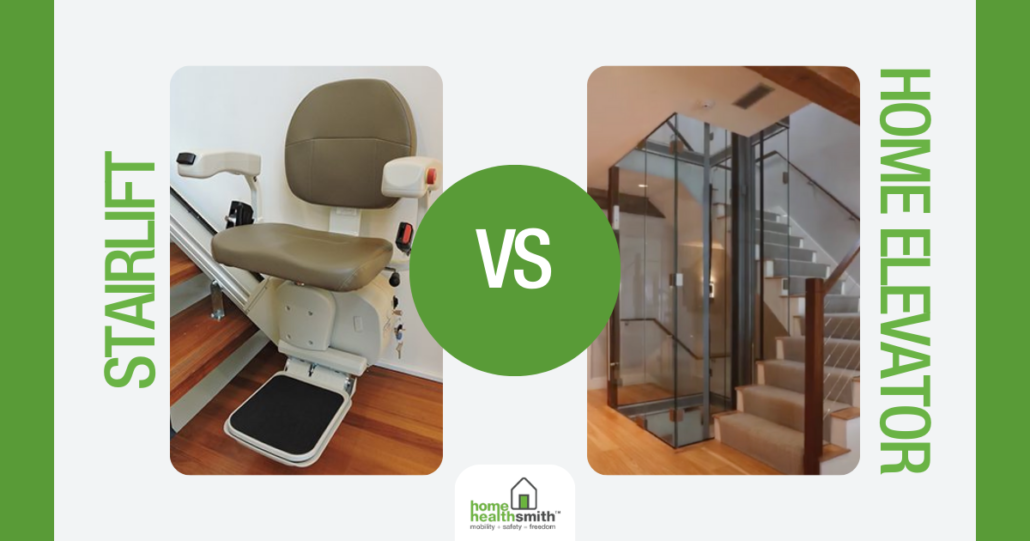
Stairlift vs. Home Elevator: Which Mobility Solution Is Right for Your Family?
When stairs become a barrier to safely accessing every floor of your home, two solutions rise to the top: stairlifts and residential elevators. Both accomplish the same fundamental goal—helping your loved one move between floors safely—but they do so in very different ways, at very different price points, and with different implications for your home.
If you’re helping an aging parent plan for the future, or if mobility changes have made this decision urgent, understanding the differences can help you make the choice that best fits your family’s needs, budget, and long-term plans.
Understanding Your Options
What Is a Stairlift?
A stairlift is a motorized chair that travels along a rail mounted directly to your staircase. The user sits in the chair, fastens a seatbelt, and uses simple controls to glide up or down the stairs. When not in use, the chair and footrest fold up to minimize obstruction of the staircase.
Modern stairlifts include safety features like obstruction sensors, battery backup for power outages, and swivel seats for easier entry and exit. They’re available for straight staircases, curved staircases (including those with landings), and even outdoor stairs.
Learn more about stairlift options and features.
What Is a Residential Elevator?
A residential elevator is a permanent vertical lift installed within your home, typically requiring a shaft or hoistway that connects two or more floors. Unlike commercial elevators, home elevators are designed for residential use and can be customized to match your home’s décor.
Modern residential elevators require less space than many people expect—typically a 5′ x 5′ footprint is sufficient. They can be installed during new construction, added during renovation, or in some cases retrofitted into existing homes.
Explore residential elevator options.
Cost Comparison
Stairlift Costs
Stairlifts are significantly more affordable than elevators. A straight stairlift typically costs between $3,000 and $5,000 installed. Curved stairlifts—which require custom-manufactured rails to fit your specific staircase—range from $10,000 to $15,000 or more, depending on complexity.
Rental options are also available for temporary needs, such as recovery from surgery. This makes stairlifts accessible for families who need an immediate solution without a major investment.
Residential Elevator Costs
Home elevators represent a more significant investment, typically ranging from $20,000 to $50,000 or more, depending on the type of elevator, number of floors served, and extent of construction required. This includes the elevator unit itself plus installation and any necessary structural modifications.
However, elevators can increase home value—according to the National Association of Home Builders, homes with elevators often command premium prices, and the investment may be partially recouped at resale.
Installation Requirements
Stairlift Installation
One of the biggest advantages of stairlifts is their relatively simple installation. A straight stairlift can typically be installed in just a few hours. The rail mounts to the stair treads (not the wall), so structural modifications are rarely needed.
Curved stairlifts take longer—usually one to two days—because the rail must be custom-manufactured to fit your specific staircase. A digital survey of your stairs ensures precise measurements.
Contrary to popular belief, stairlifts can be installed on almost any staircase: narrow stairs, steep stairs, stairs with landings or curves. If you’re wondering whether your home can handle stairlift installation, the answer is almost always yes.
Residential Elevator Installation
Elevator installation is a more involved process. It requires creating a vertical pathway (hoistway) through your home, which may involve cutting through floors, reinforcing structures, and running electrical wiring. Installation typically takes one to two weeks once construction is complete.
The easiest installations are in new construction or during major renovations, where the elevator shaft can be integrated into the design. Retrofitting an elevator into an existing home is possible but requires careful planning.
Read our tips for installing a residential elevator for more details on what to expect.
Functionality and Use Cases
When a Stairlift Makes Sense
Stairlifts are ideal when:
- The user can safely transfer from sitting to standing and walk short distances
- Budget is a primary concern
- You need a solution quickly
- The home layout makes elevator installation difficult or cost-prohibitive
- The need may be temporary (post-surgery recovery, for example)
When a Home Elevator Makes Sense
Elevators are the better choice when:
- The user relies on a wheelchair or has significant mobility limitations
- You need to transport items (laundry, groceries, luggage) between floors
- Multiple family members have mobility needs
- You’re planning for long-term aging in place and want a permanent solution
- Home value and resale considerations are important
- You’re building new or doing a major renovation anyway
A Third Option: Vertical Platform Lifts
For some families, a vertical platform lift offers a middle ground. These lifts transport a wheelchair or standing user vertically between floors, similar to an elevator, but with less construction required and at a lower cost than a full residential elevator.
Platform lifts work well for one-floor elevation changes and are often used for porch access or split-level homes.
Making Your Decision
The right choice depends on your family’s specific situation. Consider these questions:
- What are your loved one’s current mobility needs? Can they transfer from sitting to standing? Do they use a wheelchair or walker?
- How might those needs change? A stairlift may work today, but will it still be sufficient in five years?
- What’s your budget? Be realistic about what you can afford, but also consider long-term value.
- What does your home allow? Some homes easily accommodate elevators; others are better suited for stairlifts.
- How long do you plan to stay in the home? If you’re planning to age in place indefinitely, a longer-term investment may make sense.
See Both Options in Person
There’s no substitute for experiencing these solutions firsthand. We invite you to visit our Accessibility Living Suite showroom in Portsmouth, Rhode Island, where you can test ride stairlifts and see a working residential elevator.
Our team can answer your questions, discuss your specific situation, and help you understand what each solution would look like in your home—all with no pressure and no obligation.
Get Personalized Guidance
Every home and every family is different. The best way to determine which solution fits your needs is to schedule a free in-home assessment. One of our aging-in-place specialists will evaluate your home, discuss your concerns, and provide recommendations tailored to your situation.
We’ve helped thousands of families across Rhode Island, Massachusetts, and Connecticut navigate this decision. With over 40 years of experience in the mobility industry, we know the questions to ask and the solutions that work.
Schedule your free consultation: Contact Us or call 401-293-0415.